

Is the Moerane Commission an important cathartic exercise, as some witnesses believe, or is it just another fruitless enterprise likely to be buried by a compromised ANC?
Useless, fruitless and expensive.¨That’s what the more cynical witnesses who have testified think of the Moerane Commission, the three-person panel tasked with investigating politically linked violence and killings in KwaZulu-Natal.
But there are also those who have described the commission as cathartic. They are hoping it will reveal the perpetrators of political violence and the network of people who are paid to kill, as well as expose whoever leads and influences the network.
Established in October 2016 by KZN premier Willies Mchunu, and led by advocate Marumo Moerane SC, it is not the practical workings of the commission that lends itself to cynicism, but rather the possibility [probability? – Ed] that, if detrimental to the ANC, any significant revelations will be swept aside, played down or simply kept from the public.
Although Moerane has said the commissioners want the final report released, this is mostly an ANC problem – and a highly contentious national election is looming.
The commission held its first public hearing on 20 March 2017, but the groundwork for investigations started in January. Up until December 2017, over 50 people had testified before Moerane and fellow commissioners Vasu Gounden and Professor Cheryl Potgieter.
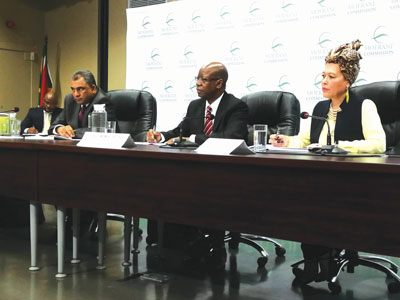 |
| Vasu Gounden, chairman Marumo Moerane and Professor Cheryl Potgieter of the Moerane Commission |
Several witnesses sought protection before and after testifying.
The commission has been extended into 2018 as more witnesses come forward wanting to testify.
Almost all testimonies follow a few common threads that are hardly secret: the ANC is dysfunctional, divided, prone to violence, and some party members are implicated in the killings for reasons that include greed – particularly a desire to climb the tenderpreneur ladder – and maintain or elevate patronage networks or one’s status within the organisation.
But one can also not rule out garden-variety criminality and turf wars over taxi routes, particularly where ANC members and officials own taxis. It has been estimated by the province’s transport department that 61 people have been killed in taxi-related violence since 2014, in a turf war between the Klip River and Sizwe taxi associations in the Ladysmith area alone.
In his October testimony, the ANC’s KZN chairman Sihle Zikalala said that, by the party’s own assessment “which is based on law-enforcement reports we have analysed, the province has recorded more than 80 political killings since 2011”.
Zikalala said that victims included party members and leaders, councillors and candidate councillors. He also said that 19 party members had been killed since January 2016 up until the time of his testimony. Two more members were killed a month after Zikalala testified.
Premier Mchunu’s office is financing the commission, with R10-R15 million budgeted for the task. “This includes the remuneration of the chairperson, other members of the commission, the secretariat and other personnel involved in the commission and related expenses, disbursements, and costs, including costs associated with the hiring of venues across the province,” said Mchunu.
Thabiso Zulu, self-styled corruption-buster and friend of slain former ANC Youth League secretary general Sindiso Magaqa, used his two-day testimony in October to thoroughly vent his spleen. He alleged that Magaqa, who had been a PR councillor at Umzimkhulu Local Municipality at the time of his death, was gunned down because he had discovered multi-million-rand corruption within Umzimkhulu, which falls under Harry Gwala District Municipality.
In his December testimony, Umzimkhulu Mayor Mphuthumi Mpabanga denied any form of corruption.
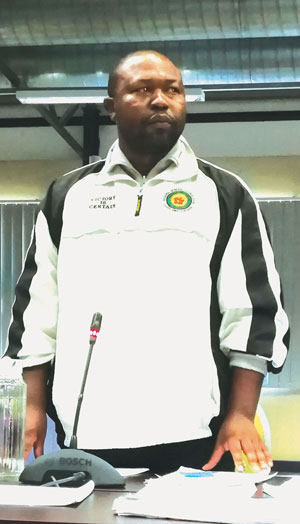 |
| Corruption fighter Thabiso Zulu, friend of slain former ANCYL secretary General Sindiso Magaqa |
Zulu told the commission: “I don’t have money, PR firms to spin things on my behalf and I don’t have security. The only thing I have is the truth, documents and courage”.
“I hope you can take the pressure from politicians who might ask the commission not to release the report because they say it could disrupt the 2019 elections. They are under siege and under pressure and [will think that] releasing the report will affect votes,” he said.
In January, Zulu told Noseweek the establishment of the commission was “not a wrong thing”, adding that it was led by “respectable people”.
“The commission may be remembered like many other commissions before it: a circus, where a lot of money was spent on lawyers, where those who sought justice for their loved ones went and cried, pleading with commissioners to help them find closure and thereafter nothing happened,” said Zulu.
It would be a tragedy, he said, if the commission’s final report ended up “gaining dust in some office somewhere” or if “politicians and securocrats” used the report to determine how much the public knows.
But, said Zulu, the commission could also serve as a “monument of truth” where brave witnesses told the world about the deaths of their friends, parents, husbands, brothers and sisters.
“They did so knowing that they may have signed their own death warrants. They did so knowing that they would be targets of a band of securocrats, rogue elements, hitmen and corrupt politicians. But they did it anyway.
“If the commission were to fail those brave men and women who appeared before it, who by appearing there were ready to sacrifice their own sweat, tears and blood for the truth, then the commission, to quote Roman poet Horace, would be ‘equal to a mountain that went into labour for a thousand years only to give birth to a ridiculous mouse’.”
| Police stand guard outside Block 52 of Umlazi’s Glebelands Hostel as commissioners inspected the squalid complex last year |
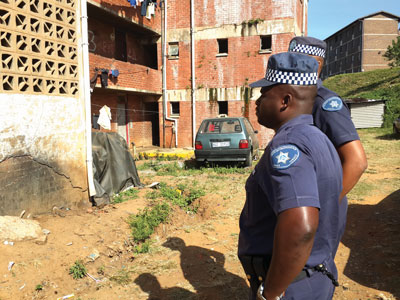
Community activist Vanessa Burger – best known for her work with victims of violence and alleged police torture at Umlazi’s bloody Glebelands Hostel (nose201) – told Noseweek that the commission had performed well “in exposing the systemic rot at the root of KZN’s violence”.
“[But] it remains to be seen whether justice will be served to any greater degree than any of the other commissions of inquiry, that, to date, have proved to be of little purpose other than costing South Africans vast amounts of money while allowing offenders to act with impunity,” said Burger. Those flaccid efforts would include the Matthews, Seriti, Hefer, Khampepe and Farlam commissions of inquiry.
“The commission’s terms of reference allow for full enforcement of the law. This must happen without political interference so that victims’ families can receive justice, closure and compensation,” Burger said.
Her testimony before the commission in July last year could be compared to a right hook to a hornet’s nest as she declared that Glebelands was a haven for hitmen operating throughout KZN and in other provinces, sometimes at the behest of politicians or police.
Glebelands is a sprawling, squalid, overcrowded complex that consists of 71 blocks and about 22,000 residents. Burger said that while the newer blocks consisted of family units, the medium and older blocks housed up to 10 people per room “at least” – rooms designed to accommodate four people.
Besides hitmen, the hostel is known to be a haven for criminals who extort money from residents and taxi owners. Burger said that money obtained during the “collections” was used to buy weapons, including police rifles, which were used in politically linked violence and other criminal acts.
Her testimony was corroborated when evidence leader, senior state advocate Bheki Manyathi, revealed during questioning that four witnesses who testified earlier in the year had made similar assertions.
Manyathi said that those witnesses testified that the killings in the province and Glebelands were a result of “politics, power, financial enrichment, criminality and failure on the part of the eThekwini municipality, SAPS and Durban Metro Police”.
Burger said that more than 90 deaths in the province could be linked to hitmen based at the hostel.
Burger also told commissioners that the KZN office of the Independent Police Investigative Directorate (Ipid) was “dysfunctional” as it had failed to collect technical reports from pathologists, had done nothing about the alleged supply of firearms to warring factions by a policeman living at the hostel, and had failed to hold identity parades of police officers alleged to be involved in some of the cases of assault and torture at Glebelands.
In December, testifying for the Ipid, national head of investigations Matthews Sesoko told the commission that its KZN office was under investigation but denied that it was dysfunctional. He said his national office had noted concerns [and] conceded that there were challenges within the KZN office. It had “instituted an investigation into such allegations by [its] Integrity Strengthening Unit”.
Sesoko said the “ongoing investigation” had identified capacity constraints which could have resulted in non-compliance with standard operating procedures. “Appropriate action will be taken against members found to have acted contradictory to the said policy.”
Testifying in July, S’bu Zikode, founder and leader of the shack-dwellers’ movement Abahlali baseMjondolo, outlined the brutality perpetrated against shack-dwellers that had resulted in several deaths (nose215). He placed the blame for the violence at the feet of eThekwini mayor Zandile Gumede and the ANC.
“I do think [the commission] will be a success, and will do what it’s supposed to do as per its mandate. It will probably exceed government expectations. However I do not believe government will take seriously or implement its recommendations,” Zikode told Noseweek. “Government has, up until today, never attempted to take reasonable steps to end [the killings in the province]. Instead, they just want to be seen to be doing something about it when they simply do not care.
“We are living evidence in our movement: no arrests or serious investigations were undertaken on the murdering of housing activists. The step taken to initiate the commission is a real a worry for the ruling party and those killing politicians within it,” he said.
 But Zikode also told Noseweek that he found the commission to be “useful” and “a healing moment”.
“For the first time in our history of losing comrades we were given a chance to publicly give testimony on our side of the story and how we feel about it. At least the public is now aware of how our loved ones were killed with impunity,” he said.
“In many of these instances the state (police) and the ruling party were implicated. The biggest challenge though will be how the state is going to reclaim the confidence of poor communities and how we are going to trust that they can protect us and that hitmen may no longer be paid with taxpayers’ money,” he said.
The Hawks are leading the investigations into the KZN killings through a political task team formed over the course of 2016 and 2017, but “Glebelands matters do not form part of the task team investigations”, according to Hawks spokesperson, Brigadier Hangwani Mulaudzi.
He said that since its inception the task team had received 44 cases, 25 of which were still under investigation, with 19 in court. “At least 69 arrests have been made thus far and 28 firearms seized.”
“It is unfortunate that most of the cases we are dealing with are purported to be politically motivated. The task team is charged with investigating these matters. It must be understood from this background that all cases are referred to the task team based on the severity of the incident. All cases are treated as murder cases thus meaning the motives will only be determined during and after the trial,” he told Noseweek.
* Research for this report was done with the support of the Taco Kuiper Fund for Investigative Journalism, administered by Wits Journalism.